In 1996, Richard Susskind published The Future of Law. Thirty years later, Oxford University Press has published a 30th-anniversary edition, The Future of Law: Reflections and Predictions. The timing could hardly be better.
When Susskind first wrote the book, email was still novel in many law offices. Google did not exist. Neither did the iPhone, LinkedIn, Facebook, TikTok, or ChatGPT. Artificial intelligence was largely something lawyers encountered in academic papers and science fiction.
Today, lawyers can speak to an AI system and receive a sophisticated response in seconds. AI can summarize thousands of pages, analyze documents, help draft contracts and briefs, search large bodies of information, translate speech in real time, and increasingly interact with software and other systems.
And we are almost certainly still at the beginning.
That is why Susskind’s new book matters.
It is not really a book about predicting which piece of technology comes next. It presents a much more important challenge:
What role will lawyers play in creating the legal system that comes next?
Oxford describes the anniversary edition as both a return to Susskind’s 1996 work and a reconsideration of it after three decades of technological change. The new edition reproduces the original work, adds reflections 30 years later, and contains a new statement of Susskind’s thinking about AI, the legal profession, access to justice, and even the possibility of artificial general intelligence.
That makes this much more than an anniversary edition.
It is an opportunity to conduct a 30-year experiment:
What did we think the future would look like? What actually happened? And what does the difference teach us about the next 30 years?
Lesson One: We Are Almost Certainly Missing Something
Susskind’s first lesson is wonderfully humbling.
When we predict the future, we naturally extrapolate from things that already exist. But history is repeatedly disrupted by what Susskind calls the “not-yet-invented” systems.
Think about standing in a law office in 1996 and trying to describe 2026.
You might have predicted faster computers.
Better legal research.
Electronic filing.
Perhaps paperless offices.
But would you have predicted that nearly every lawyer would carry a networked supercomputer in a pocket?
That billions of people would participate in social networks?
That a lawyer could have a spoken conversation with an artificial intelligence system?
Probably not.
Interestingly, Susskind’s original book already distinguished between merely automating existing work and innovating—using technology to change the way work itself is performed. Thirty years later, he continues to emphasize that distinction.
That distinction is crucial.
Putting a PDF on a computer instead of in a filing cabinet is automation.
Asking whether the document needs to exist in its traditional form at all is innovation.
Using AI to draft the same letter faster is automation.
Redesigning the process so that information is collected, verified, analyzed, and presented differently may be innovation.
The biggest mistake may be using tomorrow’s technology to recreate yesterday’s law firm.
Lesson Two: We Cannot Predict the Details—but We Can See the Direction
Susskind’s second lesson seems contradictory to the first, but it isn’t.
We will get many details wrong.
We can still identify important trajectories.
In fact, his original introduction challenged lawyers to devise new methods for delivering legal information, knowledge, guidance, and expertise—and to concentrate more heavily on the results clients actually want rather than simply perpetuating traditional methods of working.
That question has become much more urgent.
Consider what clients actually want.
A divorce client does not inherently want 17 emails, three office appointments, four forms, six hours of document preparation, and a bill measured in tenths of an hour.
The client wants to get through a divorce.
A criminal defendant does not want legal research.
The client wants someone to understand what happened, protect his or her rights, explain the choices, prepare the case, and obtain the best lawful result possible.
People do not purchase legal process because they enjoy legal process.
They purchase solutions to legal problems.
Once we understand that distinction, technology becomes much more interesting.
The question stops being:
“How can AI help lawyers do what lawyers already do?”
It becomes:
“If we were designing legal services today, with today’s technology, how would we build them?”
Those are profoundly different questions.
Lesson Three: Expertise Can Become an Anchor
Susskind’s third lesson may make some lawyers uncomfortable.
He argues that lawyers, judges, law professors, and other established participants in legal systems often respond conservatively and defensively to technological change.
There is a paradox here.
The more successful someone has become under an existing system, the harder it may be to imagine that system operating differently.
That does not make experience unimportant. Quite the opposite.
Experienced lawyers understand consequences that technologists frequently do not.
We understand privilege.
Confidentiality.
Due process.
The rules of evidence.
Conflicts of interest.
Fiduciary responsibility.
Professional independence.
And, most importantly, we understand that legal mistakes happen to actual human beings.
But expertise in the present and imagination about the future are different skills.
We should therefore distinguish between protecting a principle and protecting a process.
Attorney-client confidentiality is a principle worth protecting.
A particular method of opening a file is a process.
Competent representation is a principle.
Recording time in six-minute increments is a process.
Due process is a principle.
The fact that a particular procedure has been performed the same way for 30 years does not automatically transform that procedure into one.
We should be fiercely protective of the principles of our profession without becoming unnecessarily protective of its habits.
Lesson Four: The Future Is Something We Participate in Creating
This brings us to Susskind’s fourth lesson—and, for me, the most important.
We are not simply passengers waiting to discover where technology takes the legal profession.
We have agency.
Susskind invokes one of the great sayings of the technology world:
“The best way to predict the future is to invent it.”
And this is where the story gets fun.
Because lawyers being lawyers, we should probably Shepardize the quote.
Who Actually Invented “Invent the Future”?
The intellectual family tree begins before Silicon Valley.
In his 1963 book Inventing the Future, Nobel Prize-winning physicist Dennis Gabor wrote:
“The future cannot be predicted, but futures can be invented.”
The plural may be the most interesting word in the sentence.
Not the future.
Futures.
There isn’t necessarily one predetermined destination toward which technology is carrying us. There are alternatives. Human decisions influence which future emerges.
Computer scientist Alan Kay later became closely associated with the more famous formulation:
“The best way to predict the future is to invent it.”
The saying is associated with Kay’s work in the early 1970s, around the extraordinary period of innovation at Xerox PARC.
And that context makes the line considerably more interesting.
These weren’t people merely holding conferences about the future of computing.
They were building pieces of it.
Personal computing. Graphical interfaces. New ways for humans to interact with machines.
The distinction matters.
It is one thing to predict a future.
It is another thing to prototype it.
Management thinker Peter Drucker is also frequently credited with a related formulation:
“The best way to predict the future is to create it.”
And then popular culture gave us perhaps the most entertaining version.
And Then There Was Terminator
Yes, Terminator.
There is something wonderfully appropriate about discussing artificial intelligence, the future of humanity, and the legal profession and eventually arriving at Terminator 2: Judgment Day.
John Connor explains:
“The future’s not set. There’s no fate but what we make for ourselves.”
Put aside Skynet, time-traveling cyborgs, and Arnold Schwarzenegger for a moment.
The underlying idea is remarkably close to the others.
Gabor:
Futures can be invented.
Kay:
Invent the future.
Terminator 2:
The future isn’t set.
Susskind:
“We should not feel in law that we are simply at the mercy of future technology.”
Different voices. Different eras. One fascinating common idea:
The future is not merely something that happens to us.
That should matter enormously to lawyers right now.
Lawyers Should Not Surrender the Future of Law to Technologists
There is a strange tendency in conversations about AI to frame lawyers as its future victims.
Will AI replace lawyers?
Will AI eliminate billable hours?
Will clients stop needing lawyers?
Will machines become better advocates?
Those are legitimate questions.
But they subtly position lawyers as spectators.
I think there is a much better question:
What should lawyers build with AI?
Because lawyers possess something AI developers desperately need: domain knowledge about what a functioning legal system actually requires.
Technologists understand models.
Lawyers understand consequences.
Technologists can build capabilities.
Lawyers understand where those capabilities encounter rights, duties, privilege, procedure, evidence, ethics, and human judgment.
Neither group should build the future of legal services alone.
And clients need a seat at the table too.
Technology provides capability. Lawyers provide judgment and responsibility. Clients define the problem worth solving.
That intersection is where legal innovation becomes genuinely interesting.
The Opportunity Is Bigger Than Making Lawyers Faster
If all we accomplish with artificial intelligence is helping lawyers produce more billable work in less time, we will have dramatically underestimated this technology.
The larger question is whether technology can change who gets legal help at all.
That means examining intake.
Legal education.
Document preparation.
Case analysis.
Client communication.
Knowledge management.
Court access.
Alternative fee structures.
Preventive legal services.
And potentially entirely new categories of legal assistance.
It also means confronting an uncomfortable truth: many legal problems currently go unresolved because traditional legal services are simply too expensive or inaccessible.
Technology alone will not solve that problem.
But technology combined with responsible legal judgment may allow us to design services that previously could not economically exist.
That is an extraordinary opportunity.
The great legal-AI breakthrough may not be replacing a $500-per-hour task with a machine.
It may be making meaningful legal help available to someone who previously received none.
But “Inventing the Future” Does Not Mean Abandoning Judgment
There is an important qualification.
Innovation cannot become an excuse for recklessness.
An AI system can be astonishingly capable and still be wrong.
A beautiful interface can conceal unreliable reasoning.
Automation can make an error travel faster.
And efficiency is not the same thing as competence.
Lawyers therefore have a particularly important role in designing the safeguards surrounding legal AI.
Who verifies the result?
What evidence supports it?
What information was considered?
What information is missing?
When does the system stop?
When must a human intervene?
Who is responsible when something goes wrong?
Those are not annoying questions standing in the way of innovation.
Those questions are part of the innovation.
The future legal system needs engineers.
It also needs lawyers willing to think like architects.
From Automation to Reinvention
One of the most interesting aspects of revisiting Susskind’s original work is seeing how mundane some once-futuristic technologies now appear.
His 1996 case studies discussed document-management systems, management-information systems, email, knowledge systems, and early legal AI.
Email.
Think about that.
A technology once worthy of discussion in a book called The Future of Law became so ordinary that lawyers now complain about receiving too much of it.
That should teach us some humility about today’s extraordinary technologies.
Today’s AI demonstration may become tomorrow’s boring infrastructure.
Which means our job is not simply to master today’s applications.
It is to build organizations capable of adapting repeatedly.
That requires institutional knowledge.
Clean data.
Documented processes.
Security.
Human review.
Experimentation.
Education.
And perhaps most importantly, a culture in which asking “Why do we do it this way?” is welcomed rather than feared.
Thirty Years From Now
Imagine another anniversary edition in 2056.
Some lawyer will read about ChatGPT, generative AI, autonomous agents, and the systems we considered revolutionary in 2026.
Perhaps they will seem quaint.
Perhaps artificial general intelligence will have transformed legal work. Susskind’s new restatement expressly confronts the “what if AGI?” question and considers its implications for dispute resolution, the professions, and lawyers themselves.
Or perhaps the future will develop in directions none of us currently anticipate.
That is precisely Susskind’s point.
We will get things wrong.
There will be technologies we cannot presently imagine.
But uncertainty about the future does not relieve us of responsibility for helping create it.
Quite the opposite.
It makes participation more important.
So perhaps we can reduce 60 years of thinking about technological change to four increasingly memorable formulations:
Dennis Gabor, 1963:
“The future cannot be predicted, but futures can be invented.”
Alan Kay, 1971:
“The best way to predict the future is to invent it.”
Terminator 2, 1991:
“The future’s not set. There’s no fate but what we make for ourselves.”
Richard Susskind, 2026:
“We should not feel in law that we are simply at the mercy of future technology.”
There is a message here for every lawyer.
Stop asking only what artificial intelligence is going to do to our profession.
Start asking what we are going to do with it.
Protect what deserves protecting.
Question what exists merely because it has always existed.
Experiment responsibly.
Design around clients.
Use technology to expand what lawyers can accomplish rather than merely accelerating what we already do.
And remember that the future of law is not sitting somewhere in 2036 waiting for us to arrive.
We are building it right now.
Perhaps John Connor had it right after all.
NO FATE.
The future isn’t set.
For lawyers, I would add just one footnote:
Invent boldly. Verify carefully. And, naturally, check the citations.
Richard Susskind’s The Future of Law: Reflections and Predictions (30th Anniversary Edition) was published online by Oxford University Press on August 17, 2026, with the print edition available September 24, 2026.
Read the book
The Future of Law: Reflections and Predictions — Oxford University Press
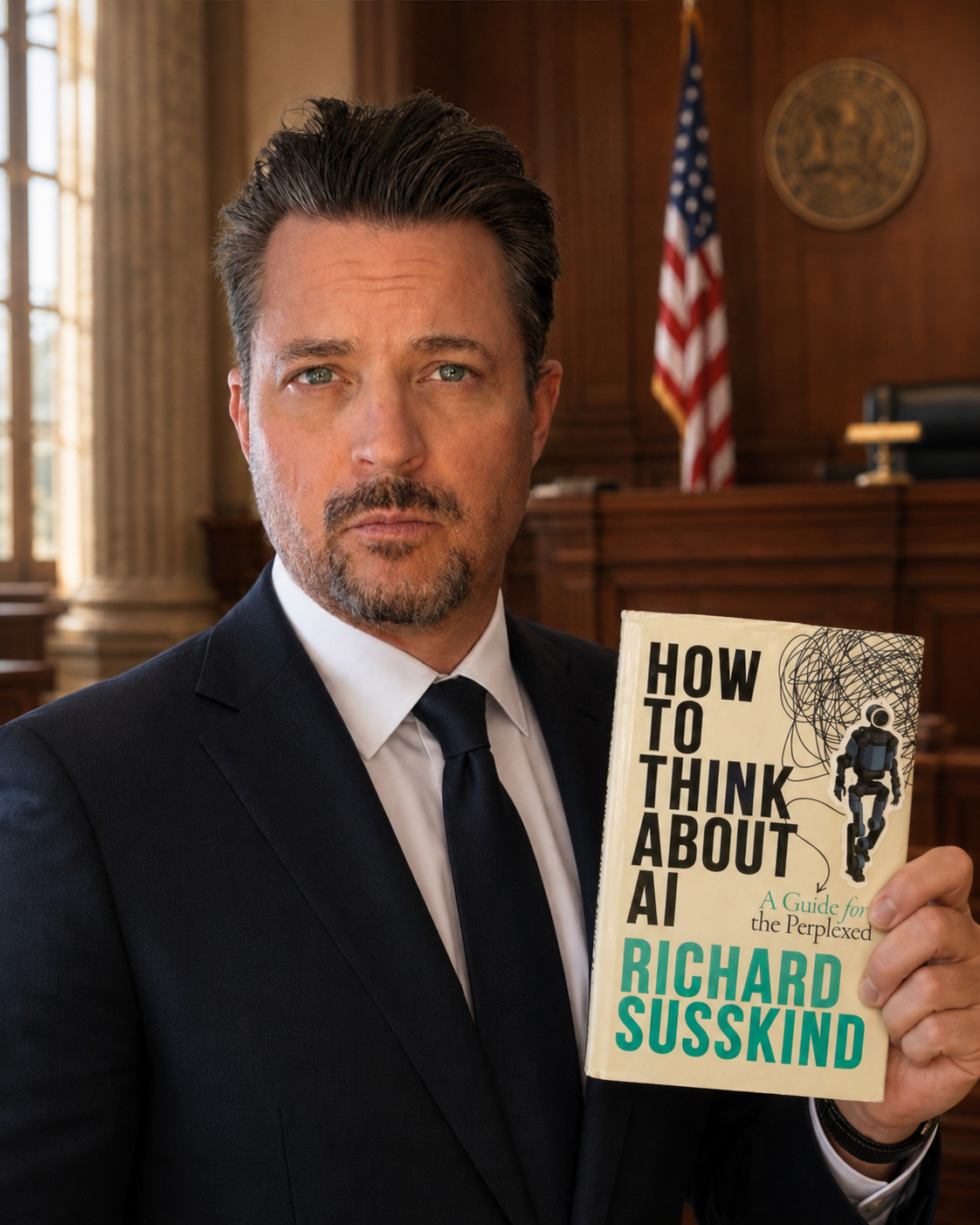
See also: Susskind’s How to Think About AI.
Disclaimer: This article is for general informational and educational purposes only and does not constitute legal advice. LegalTek.ai is a technology company, not a law firm.